
Can PhD Holders Still Apply Directly in Shanghai for PR? New Policy Has Given Answer
If you have lived in Shanghai, or have talked about this with friends, you have probably heard one common line:
👉
“A PhD holder who works in Shanghai can directly apply for permanent residence.”
And in actual practice at that time, the process was also relatively lenient:
● Salary was not heavily emphasized
● Work experience requirements were not strictly enforced
● Whether the job was perfectly aligned with the applicant’s academic background was not examined so strictly
👉 So many people came to assume:
A PhD = a relatively direct pathway to Shanghai Permanent Residence
But now, that logic has changed.
And the change is not minor. The underlying rules themselves have been replaced.
Path 1: Income-Based Eligibility
● Continuous employment for at least 3 years
● Annual income ≥ 3 times the Shanghai average salary
● Normal tax payment record
👉 This path is closer to the traditional logic for “high-income talent.”
Path 2: Degree + Field Alignment Eligibility (This Is the Route Most PhD Holders Will Rely On)
● Continuous employment for at least 3 years
● The applicant’s graduating institution must be:
○ a Double First-Class university
○ or a Global Top 100 university
● The applicant’s current job responsibilities must be closely aligned with the PhD field of study
👉 This path appears to be “designed for PhD holders,”
but in reality, the review is more detailed and more stringent.
One more point worth noting:
👉 A spouse and minor children may apply together as accompanying family members (this remains a favorable aspect of the policy).

👉
Before: having a PhD meant you could apply.
👉
Now: having a PhD only means you may enter the screening process.
To put it more concretely, the changes are very clear:
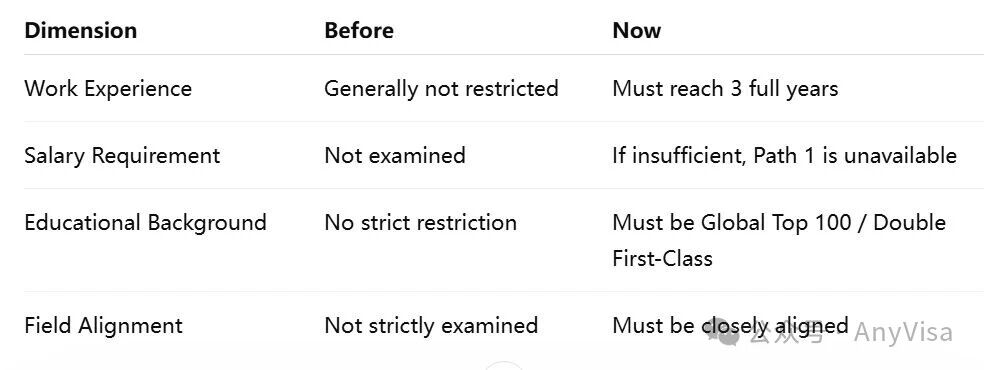
from “providing an opportunity” to “conducting a screening.”
● PhD in Computer Science
● University qualified within the Global Top 100
● Worked in two companies in Shanghai, with a cumulative employment history of more than 3 years
● Has consistently worked in technical positions that are highly aligned with the academic field
It follows the Degree + Field Alignment Path.
So:
● There is no need to meet the 3-times-average-salary threshold
● The core issue is whether the applicant’s work is professionally aligned with the PhD field
👉 Under the new policy, this is a typical and workable route.
❌ Case 2: The Applicant’s Background Is Not Weak, Yet the Case Is Blocked Immediately
● PhD degree (but not from a Global Top 100 university)
● Nearly 4 years of work experience in Shanghai
● Income is good, but still below 3 times the Shanghai average salary
● The position is management-oriented and only weakly related to the PhD field
👉 Neither of the two paths works:
● Income is insufficient → Path 1 does not apply
● School background + field alignment do not satisfy the requirements → Path 2 does not apply
👉 The result is:
In the past, this person could still try. Now, there is not even a qualifying path available.

Many PhD holders instinctively think:
👉 “I have the degree, so I should be fine.”
But the real question now is:
👉 It is no longer about whether you can file an application, but whether you actually qualify under a valid path.
❌ 2. Underestimating the Importance of Field Alignment
👉 Many people assume that working in a related industry is enough.
But what the review focuses on more closely is:
👉 Whether the work you are actually doing is directly related to your PhD research direction.
❌ 3. Failing to Plan the 3-Year Period in Advance
👉 The 3-year requirement is now rigid.
But even more importantly:
● Whether the employment is continuous
● Whether the company is suitable
● Whether the role is properly aligned
👉 In many cases, the outcome has effectively already been determined by the applicant’s first job.

👉 First determine whether you can enter one of the two paths.
If the answer is yes:
👉 Then it becomes a matter of preparing the required documents.
If the answer is no:
👉 Then the key issue is no longer the application itself, but how to adjust your path.
For example:
● Whether you need to adjust your role direction
● Whether you need to wait for more time to accumulate
● Whether you need to move to a platform that is more aligned with your background

① Does Your PhD Granting Institution Meet the Current Requirements?
● Is it a Double First-Class university?
● Or is it within the Global Top 100?
② Is Your Current Work Closely Aligned With Your PhD Field?
👉 Can you clearly explain:
● Your actual work content
● Your job responsibilities
● How those responsibilities correspond to your research direction
③ Have You Already Met the Requirement of 3 Years of Continuous Employment?
👉 And also:
● Has your employment been continuous?
● Has your employer situation remained stable?
👉 If among these three questions:
● 1 or 2 items remain uncertain
● or your case is exactly on the borderline
then it is in fact very necessary to conduct a more specific assessment before deciding whether to apply.
If you are now:
● already working in Shanghai
● or have just graduated and are preparing to develop your career in Shanghai
you can also assess your path in advance and avoid unnecessary detours.