
New China Visa Policies Updated in September
1. Foreign Shareholder Dividends: 20% IIT Effective from September 1
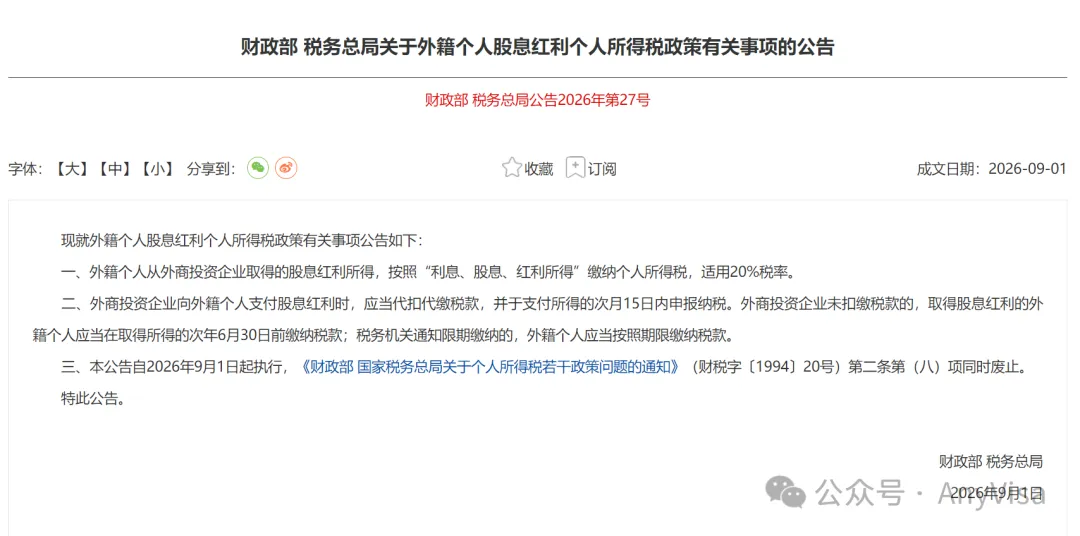
From September 1, 2026, this exemption no longer applies. Such income is now taxed as “income from interest, dividends and bonuses” at a rate of 20%.
When a foreign-invested enterprise distributes dividends or bonuses to a foreign individual, the enterprise must withhold the Individual Income Tax and file the tax return by the 15th day of the following month. If the enterprise fails to withhold the tax, the foreign individual receiving the dividends or bonuses must pay the tax in accordance with the law.
2. PR for Ethnic Chinese: Only ONE Former Chinese Passport Now Required
Ethnic Chinese applicants who previously held Chinese citizenship were generally required to submit all their former Chinese passports when applying for Chinese permanent residence.
Under the latest requirement, applicants only need to provide one of their former Chinese passports, rather than their complete passport history.
3. PR: Former Taiwan Residents May Apply with Proof of Nationality Loss
Former Taiwan residents who later acquired another nationality previously faced restrictions when preparing documents for Chinese permanent residence.
They may now apply for Chinese permanent residence using proof of the loss of their former nationality.
4. PR: Korean Applicants Need Passport–ID Identity Proof

This is because Korean non-criminal record(NCR) and certain other official documents follow a fixed format that shows only the applicant’s Korean resident registration number instead of their passport number.
The additional certificate links these Korean documents to the applicant’s passports, confirming that the person named in the NCR and the passport holder are the same person.
5. Shanghai – New Birth Certificate Copy Rule for Spouse-Reunion PR
A photograph of the birth certificate is not accepted for submission.
6. Work Permit Applications: Extra Proof Required When the Degree Level Is Unclear
If the certificate only states “Diploma” or does not specify a degree level, the applicant must additionally provide either:
● a degree-equivalency statement issued by the embassy or consulate in China of the country where the qualification was obtained.

7. Shenzhen – Social Insurance Records Now Required for Work Permit Renewals
Foreign nationals renewing their Foreigner’s Work Permit in Shenzhen needs to provide their social insurance contribution record with the employing company now.
8. Nanjing – Legal Representatives Must Select “Corporate Management Personnel” for Class B Work Permit Applications
In Nanjing, when a company’s legal representative applies for a Class B Foreigner’s Work Permit based on a bachelor’s degree and two years of relevant work experience, the personnel type must be listed as “Corporate Management Personnel”, regardless of the applicant’s actual position.