
Do Foreigners in China Have to Pay Social Insurance? (Yes – But Read This First)
Lately, we’ve been getting more and more questions about social insurance for foreign employees.
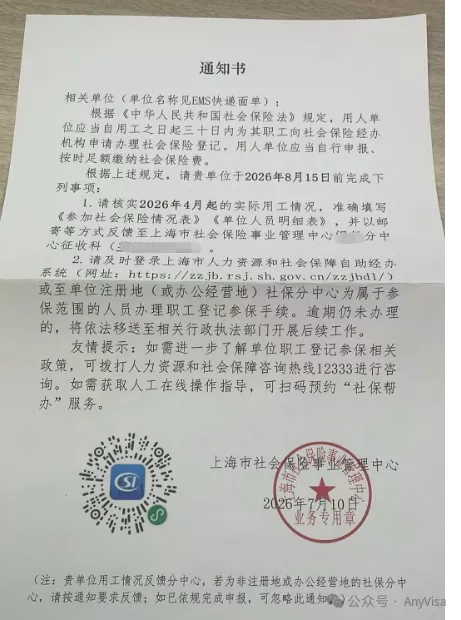
Some companies have also started receiving official notices from social security authorities about employee enrollment (see image below) – which has left many wondering:
“Are they now checking foreign employees specifically?”
“What if we haven’t been paying?”
“Do we need to backpay immediately?”
Let’s break down what actually applies.
1. The Short Answer: Yes, in most cases
If you hold a valid work permit and residence permit in China, and you have a formal employment relationship with a Chinese company, you are generally required to participate in China’s social insurance system.

- Pension insurance
- Medical insurance
- Work-related injury insurance
- Unemployment insurance
- Maternity insurance
Being a foreigner is not an exemption by itself. Both employer and employee are expected to contribute accordingly.
2. Why the Sudden Attention?
Recently, many companies have started receiving enrollment status notices from local social security bureaus.

Important: This does not necessarily mean a full-scale audit or penalty process has begun. Different cities and districts are handling it differently. But it does signal that foreign employee social insurance is getting more attention – and it’s worth taking seriously now, rather than later.
3. Social Insurance Agreements – Some Countries Are Exempt (Partially)
China has bilateral social security agreements with several countries, including:
- Germany
- Japan
- South Korea
- France
- Canada
(and a few others)
If you are a citizen of one of these countries and meet specific conditions, you may be exempt from certain parts of China’s social insurance for a limited period.

So whether you need to pay depends on:
- Your nationality
- Your employment status
- Your city
- Whether a bilateral agreement applies
4. “I Already Pay Insurance in My Home Country – Does That Count?”
Not automatically.
Having social insurance in your home country does not mean you are exempt in China. Only if a bilateral social security agreement between China and your home country specifically covers your situation, and you meet the conditions, can you apply for exemption.

💡: Paying abroad ≠ automatic exemption in China.
5. What If You Leave China Permanently?
If you leave China and terminate your employment, your social insurance account is not simply wiped out.
Your pension account can be retained.
If you return to work in China later, your previous contributions may still count.
You may also apply to close your account and withdraw the balance, subject to current regulations.
So even if you’re not staying long-term, the contributions are not lost.
6. Work Permit, Tax, and Insurance – Check All Three
For foreign employees, work permits, personal income tax, and social insurance are connected.

If you’re planning to stay long-term, it’s wise to confirm:
- Your work permit is valid
- Your taxes are filed correctly
- Your social insurance is being contributed properly
Don’t wait until renewal or visa extension to find out something was missed.
Final Takeaway
There are exceptions – mainly for citizens of countries with bilateral social security agreements who meet specific conditions. But those are case‑by‑case.
If you’re unsure about your own situation – whether you should be paying, which contributions apply, or if you qualify for an exemption – it’s best to check early.
A quick review now saves much bigger headaches later.